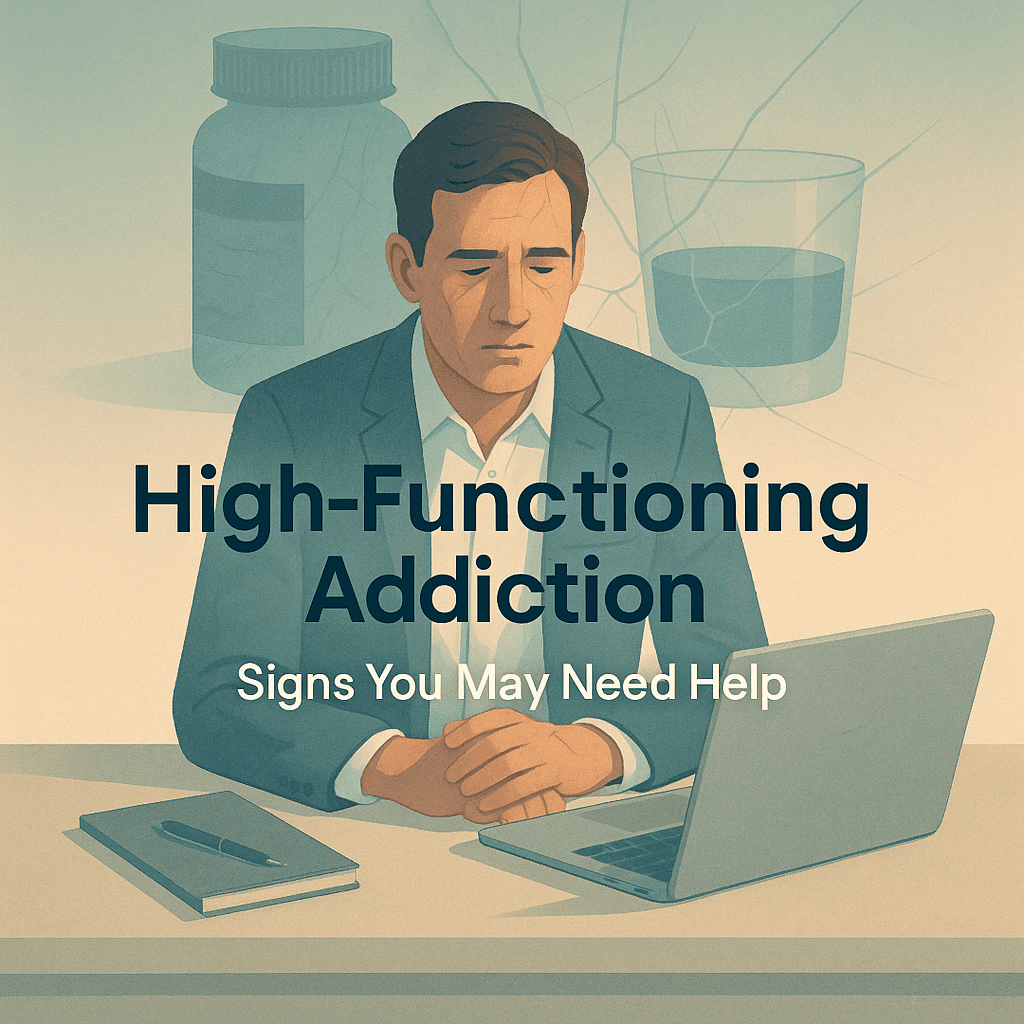
 The term “high functioning addiction” might sound almost harmless at first glance. It suggests that you are managing to get things done, still showing up for work or social obligations.
However, this is exactly why such an addiction can persist unnoticed for a long time. If you’re maintaining a job, keeping up with responsibilities, paying bills, perhaps even working out regularly and posting seemingly normal photos on social media, it becomes all too easy to convince yourself that your situation isn’t serious. But addiction doesn’t always manifest as chaos; sometimes it presents itself as control, routines, performance, and a façade of normalcy.
The term “high functioning” is not a distinct type of addiction; rather, it represents a stage in the addiction journey. For many individuals, it’s the phase where everything appears fine externally while internally, the struggle intensifies – becoming louder, harder and more exhausting. This post aims to help you identify the signs that indicate it might be time to seek support—not because you’ve hit rock bottom, but because you’re weary of carrying this burden.
What “high functioning” can actually look like day to day
Many people associate addiction with missed workdays, visible intoxication, broken relationships and dramatic life changes. While these scenarios do occur, “high functioning addiction” often looks quite different. It may involve:
- Being the dependable one who never misses a deadline.
- Engaging in substance use after work but still managing to wake up and fulfill daily responsibilities.
- Keeping your living space tidy, your schedule full and your narrative consistent.
- Mastering the art of appearing normal even when you feel anything but.
- Having a “system” in place that gives an illusion of being managed.
You might even take pride in that system until you realize the immense energy it demands to sustain it.
Moreover, high functioning addiction can also come with an underlying constant fear. A nagging thought that if anyone truly understood how much you rely on this coping mechanism, they would perceive you differently.
If any of this resonates with you, it doesn’t imply that you’re broken. It signifies that your nervous system and coping strategies have been overworked.
Recognizing these signs is crucial. For instance, if you find yourself drinking excessively yet still managing to function at work or maintain relationships – a classic sign of being a “high functioning alcoholic“, it’s time to reflect on your habits.
Understanding these patterns is vital for acknowledging the need for help. It’s important to remember that seeking support is not an admission of failure but rather a courageous step towards reclaiming control over your life.
Sign 1: You need it to feel normal, not to feel good
This is a big one, and it is easy to miss.
In the beginning, substances can feel like they add something. Relief. Confidence. Sleep. A break from your brain. Later, it is not about adding. It is about avoiding withdrawal, irritability, restlessness, that edgy uncomfortable feeling.
You might notice:
- You drink or use just to take the edge off, almost automatically.
- Your baseline mood feels off until you have it.
- You promise yourself you will not today, then you do, because the day feels unmanageable without it.
- You feel kind of flat or foggy when you are sober, like life is muted.
And because you are still functioning, you may tell yourself it is not dependence. But needing something to feel normal is one of the clearest signals that your body and brain have adapted to addiction.
Sign 2: Your “rules” keep changing
High functioning addiction loves rules. Rules create the illusion of control.
You might have rules like:
- Only on weekends.
- Only after 6 pm.
- Only socially.
- Only wine, no liquor.
- Only gummies, not smoking.
- Only one, then I stop.
But then stress hits. Or you had a hard day. Or you are celebrating. Or you are bored. And the rule shifts.
And you might notice this pattern where you break the rule, feel uneasy about it, then create a new rule that seems more realistic. That cycle can go on for years.
The real question is not whether you have rules. It is whether you can keep them consistently without white knuckling, bargaining, or feeling secretly panicked.
In such situations, it’s crucial to seek help and rebuild your confidence and identity after addiction. Whether it’s heroin or any other substance that’s causing these changes in your life, understanding addiction and its impact is the first step towards recovery.
Furthermore, it’s essential to recognize that these “rules” often stem from a deep-seated need for control which can lead to a vicious cycle of addiction where breaking these self-imposed rules results in guilt and further substance use as a coping mechanism.
Sign 3: You are doing great, but you do not feel okay
This is the quietest sign, and the one people ignore the longest.
From the outside, your life might be objectively successful. But internally, you feel:
- Wired and tired at the same time
- Detached, like you are watching yourself live
- Restless when things are calm
- Numb in moments that should feel meaningful
- Irritable over small things, then guilty about it
High functioning addiction often rides alongside anxiety, depression, trauma, ADHD, perfectionism. Sometimes it started as self medication. Sometimes it became the only way you knew how to downshift.
If you feel like you are constantly “on,” substances can become the off switch. And when that off switch becomes necessary, it is not really a choice anymore. This is a classic sign of dual addiction, where one addiction coexists with another mental health issue.
If you want to talk this through with someone who actually gets the high functioning piece, you can reach out to us at West LA Recovery. Even a short, private conversation can bring a lot of clarity.
Sign 4: You are always thinking about when you can have it
Not necessarily in an obsessive, dramatic way. More like a constant background tab open in your brain.
- Planning your evening around it
- Choosing events based on whether it will be available
- Feeling annoyed when something interrupts it
- Counting down the hours until you can finally relax
- Getting anxious if you are not sure you will have enough
This is one of those signs that can show up even when consequences have not hit yet. Because it is not about consequences. It is about mental real estate.
When a substance starts taking up that much space, life begins shrinking around it, even if your schedule is full. This kind of behavior often indicates a deeper issue such as alcoholism.
It’s essential to recognize these signs early and seek help. At West LA Recovery, we understand the complexities of addiction and offer tailored addiction recovery programs to help individuals reclaim their lives.
Remember, it’s possible to grow stronger in recovery and overcome these challenges. The journey may be tough, but with the right support and resources, it’s achievable.
The struggle with addiction often leads to a psychological battle where we crave what harms us. Understanding this aspect of addiction can be crucial in the recovery process.
Sign 5: Your relationships are being “managed”
High functioning addiction can turn you into a manager of perception. This kind of behavior is often a clear sign of substance use.
You might:
- Avoid staying over at someone’s place because your routine would be interrupted
- Keep certain friends at a distance because they would notice
- Date people who drink or use similarly, because it feels safer
- Get defensive if someone asks a simple question
- Tell small lies that feel justified, because you do not want a conversation
You may not be blowing up relationships. You may still be showing up. But there is a difference between being present and being careful.
Sometimes the biggest relationship cost is not conflict. It is that you are not fully reachable.
Sign 6: You recover like it is a sport
A lot of high functioning people are good at damage control. This could stem from common myths about addiction, which may lead to unhealthy coping mechanisms.
You might:
- Have a whole hydration and supplement routine
- Know exactly how to cover a hangover
- Be weirdly proud of how little sleep you can run on
- Use caffeine, workouts, cold plunges, or productivity hacks to counterbalance
- Keep pushing through, because you always have
To be clear, taking care of your body is not the problem. The problem is when recovery becomes part of the addiction cycle. Like, you know you will overdo it, but you already have a plan for how to bounce back.
That bounce back can mask how much your system is being strained. If you’re struggling with these signs and need help, consider reaching out for professional guidance through available addiction resources or specialized alcohol addiction centers. It’s important to understand that seeking help does not carry the stigma of addiction, and it’s okay to ask for support in your recovery journey.
Sign 7: You have “mini withdrawals” and call them stress
Withdrawal does not always look extreme. Sometimes it looks like:
- Waking up at 3 am with your heart racing
- Sweating more than usual
- Shakiness, nausea, headache, or that weird body anxiety
- Snapping at people, then feeling confused about why
- Feeling depressed for no obvious reason
- Needing a drink or hit to settle your stomach or calm your mind
And you may chalk it up to work pressure, parenting, hormones, burnout, traffic, life.
Sometimes it is life. And sometimes it is your body asking where the substance went.
If you are unsure, it is worth getting a professional assessment. It does not commit you to anything. It just gives you an honest read on what is happening.
Sign 8: You keep “proving” you do not have a problem
This one is uncomfortable, but important.
High functioning addiction can make you set up little tests:
- Taking a few days off, just to show you can
- Switching substances, because that feels healthier
- Comparing yourself to someone who has it worse
- Listing your achievements as evidence
- Telling yourself, I never drink in the morning, so I am fine
But if you are repeatedly trying to prove you are fine, that usually means part of you is not convinced.
Real freedom is not proving you can stop. It is not needing to.
Sign 9: Your tolerance is climbing, quietly
You might not be drinking “a lot” in your mind. But compared to you two years ago? Five years ago?
Tolerance often looks like:
- You need more to feel the same effect
- What used to be enough now feels pointless
- You drink or use faster than you used to
- You barely feel it, but you still keep going
This is one of the ways the brain adapts. And it is one of the ways people accidentally cross into dependence while still looking totally put together.
Sign 10: You have scary moments, then you minimize them
Even high functioning addiction has moments that break through the “I am fine” story.
- A blackout or a fuzzy night you cannot fully recall
- Driving when you should not have
- Saying something cruel or out of character
- A panic attack after using
- Mixing substances because you were not thinking
- Waking up with dread, promising never again
And then a few days later, things stabilize. You catch up at work. You handle responsibilities. The fear fades. So you tell yourself it was a one off.
But if those moments are happening at all, it is worth paying attention. Not with shame. With honesty.
Sign 11: You cannot rest without it
Some people are not chasing a high. They are chasing permission to stop.
If you feel like you cannot relax, sleep, eat, socialize, or enjoy a quiet night without a substance, that is a sign your nervous system has learned a very specific association.
Substances can become the bridge between you and rest.
And that is heartbreaking, honestly. Because rest is supposed to be yours. You are allowed to have it without negotiating with a bottle, a pill, a vape, or a baggie.
However, this dependency on substances for normalcy and relaxation can often lead to an identity crisis where individuals struggle to find their true selves without these substances.
What keeps high functioning addiction stuck
A few things, usually.
- People praise your productivity. No one questions you because you are performing.
- You question yourself. Because you still have a job, a family, a life.
- You are scared of losing your edge. Like sobriety will make you boring, slower, less sharp.
- You are scared of feeling everything. Without the buffer.
Also, high functioning people are often used to solving problems alone. That independence can become a trap. Because addiction is not a willpower problem. It is a support problem, a coping problem, a nervous system problem, a relationship with pain problem. Usually a mix.
When “should I get help?” becomes the wrong question
A better question is: Is this costing me more than I want to pay?
Not just money. Energy. Mood. self respect. health. time. connection.
You do not have to wait for a catastrophe. You can choose help when it is still quiet enough to think clearly.
At West LA Recovery, we work with people who look fine on paper and feel exhausted behind the scenes. If you are wondering what options make sense for you, reach out. We can walk you through it without pressure, and without turning it into a big dramatic thing.
What getting help can actually look like (it is not one size fits all)
Some people avoid reaching out because they think help means disappearing for months or telling everyone.
Sometimes treatment is inpatient or outpatient, sometimes it starts with detox or therapy, medication support, or a structured program that lets you keep working – like our group therapy or individual therapy for addiction.
The point is not the label but getting you stable, clear headed, and supported in a way that fits your life and safety.
If you have been holding it together for a long time, you might even feel weirdly guilty admitting you need help – like you do not deserve it because you are not “that bad.”
But needing help is not a competition.
It’s important to recognize when partying crosses the line into addiction, and understanding what to expect during your first addiction therapy session can ease some of that anxiety.
Remember that there are various types of therapies available such as EMDR therapy for addiction which may suit your needs better than traditional methods.
A quick self check you can do today
Not a diagnosis. Just a mirror.
Ask yourself, and answer quickly, no overthinking:
- If I had to stop completely for 30 days, what emotion comes up first?
- Do I use to change how I feel, or to avoid how I feel?
- Have I hidden the amount, frequency, or impact from anyone?
- Do I feel relief when I know I have enough?
- Have I tried to cut back and ended up right where I started?
- Does my life feel smaller than it used to?
If your answers made your chest tighten a bit, that is information.
And if you want, you can bring that exact list into a conversation with us at West LA Recovery. We will help you sort out what is going on and what level of care actually makes sense. Simple. Private. No judgment.
The part nobody says out loud
High functioning addiction can feel like you are two people.
One who is competent, funny, productive, dependable.
And one who is scared of what happens if the substance is taken away. Or scared of what you might feel if you finally stop outrunning yourself.
You are not crazy for that split. It is common. And it is fixable. Not overnight, not with a perfect morning routine. With real support, real tools, and a plan that does not rely on you being superhuman.
If you’re silently reflecting and thinking, “I might be closer to the line than I want to admit,” that is enough reason to reach out. You do not have to hit bottom to choose something better.
It’s important to understand that trauma can significantly impact addiction, and acknowledging this connection is the first step towards healing. Our team at West LA Recovery specializes in providing comprehensive addiction recovery tailored to your unique needs.
FAQs (Frequently Asked Questions)
What is high functioning addiction and how does it differ from other types of addiction?
High functioning addiction refers to a stage in the addiction journey where an individual maintains external responsibilities like work, social obligations, and personal routines, while internally struggling with addiction. Unlike more visible forms of addiction marked by chaos or missed commitments, high functioning addiction presents as control, routines, and a façade of normalcy, making it harder to detect.
What are common signs that indicate someone might have a high functioning addiction?
Signs include consistently meeting deadlines while using substances after work, maintaining a tidy living space and full schedule, feeling the need to use substances just to feel normal rather than good, frequently changing personal rules about substance use, and experiencing internal feelings of restlessness, numbness, or irritability despite outward success.
Why do people with high functioning addiction often create rules around their substance use, and what happens to these rules over time?
People create rules like ‘only on weekends’ or ‘only socially’ to maintain a sense of control over their substance use. However, stress or emotional triggers often cause these rules to shift or break. This cycle of setting and breaking rules can continue for years, leading to feelings of guilt and reinforcing the addiction.
How can I tell if I need support for high functioning addiction even if I haven’t hit rock bottom?
If you find yourself relying on substances just to feel normal rather than to enhance mood, notice your personal rules around use keep changing, or feel internally unwell despite external success—such as feeling wired yet tired or emotionally numb—it may be time to seek support. Recognizing these signs early is a courageous step toward reclaiming control.
Is seeking help for high functioning addiction a sign of failure?
No. Seeking support is not an admission of failure but rather a brave and proactive decision to regain control over your life. Addiction can exhaust your nervous system and coping strategies regardless of external appearances; acknowledging this is essential for recovery.
Can high functioning addiction coexist with anxiety and how does it affect daily life?
Yes. High functioning addiction often rides alongside anxiety. Individuals may experience internal restlessness, detachment from their own lives, irritability over small things followed by guilt, and difficulty finding meaning in moments that should feel significant—all while appearing successful externally. This interplay complicates the experience but also highlights the importance of comprehensive support.